Who gets UTIs, and who doesn't.
Spoiler alert: the answer involves your genes, your blood type and your biology. A plain-English guide from a biologist on why some women get bladder infections again and again while their friends never do, and what helps prevent them.
Where should I send it?
The guide is yours the moment you sign up. No spam, and you can unsubscribe any time.
No test needed to read it. If you already have a genomic report, it will make a lot more sense afterward.
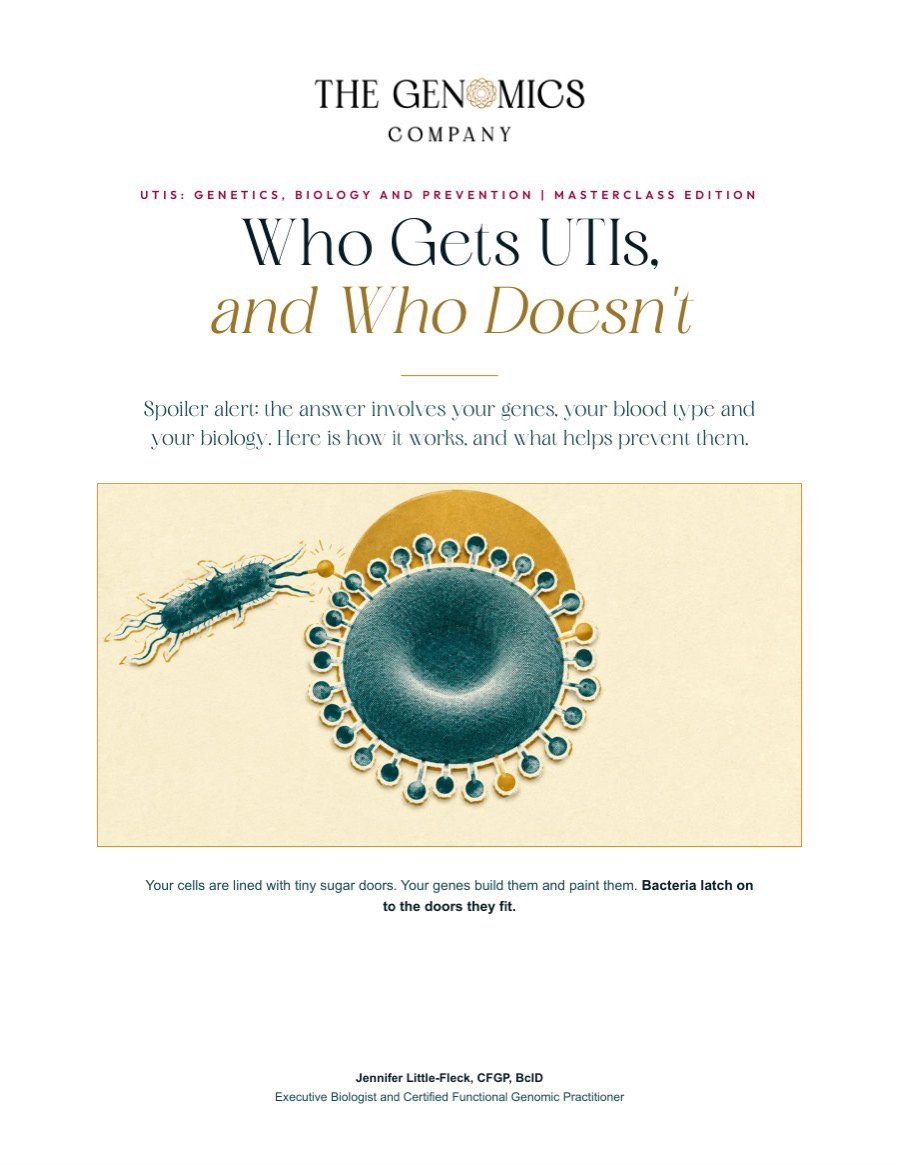
Some women get UTIs again and again. Others almost never do.
Part of the reason is anatomy, part is hormones, and part is written in your genes. Your cells are lined with tiny sugar doors, and the bacteria behind most UTIs latch on to the doors they fit. A gene called FUT2 builds the doors, and your blood type paints them. Once you see the doors, a lot of frustrating patterns start to make sense.
Why your friend never gets them, and you do.
Why they came back every time a relationship was new.
Why the test comes back negative when it still burns.
Why they started again around menopause.
Most people are surprised by how much of this is a genetic tendency. That is good news: when you have a question, there is at least part of an answer.
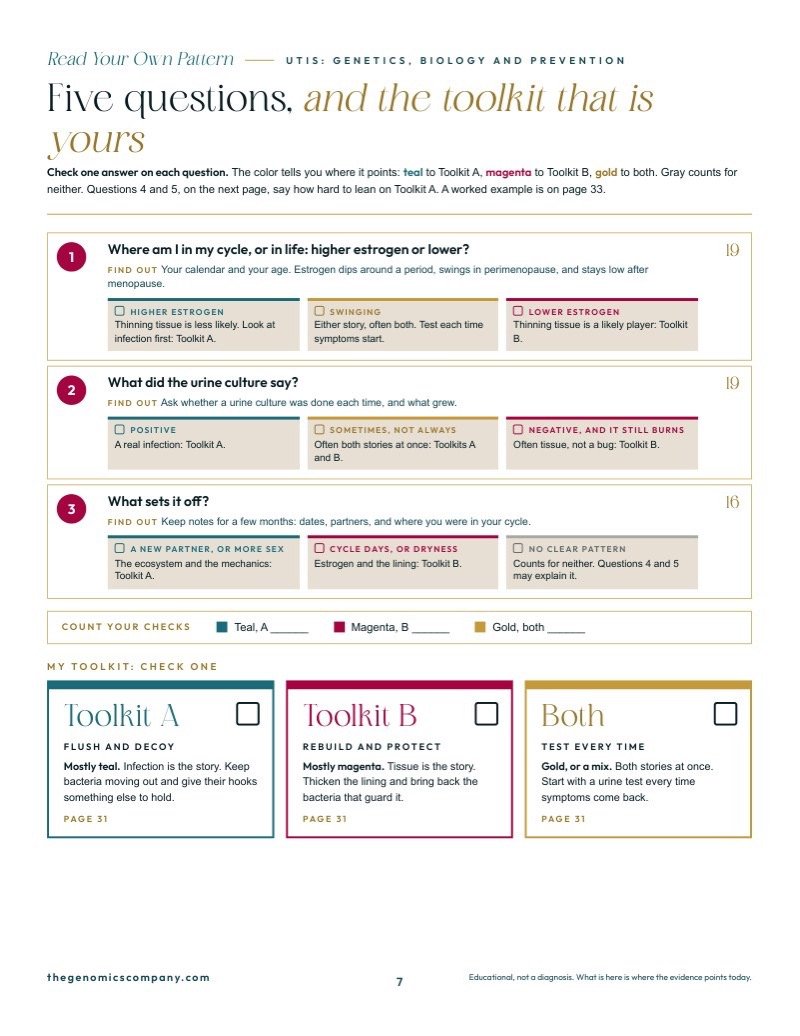
Five questions explain your pattern. Your answers point to your toolkit.
The guide walks you through the five questions that explain why UTIs find you, then gives you a two-page worksheet to print and fill in. When you finish, you know which toolkit fits you, the first thing to change, and the question to bring to your doctor.
- Where am I in my cycle, or in life: higher estrogen or lower? The first question, and a huge clue.
- What did the urine culture say? Infection, thinning tissue, or both.
- What sets it off? A new partner, your cycle, or no clear pattern at all.
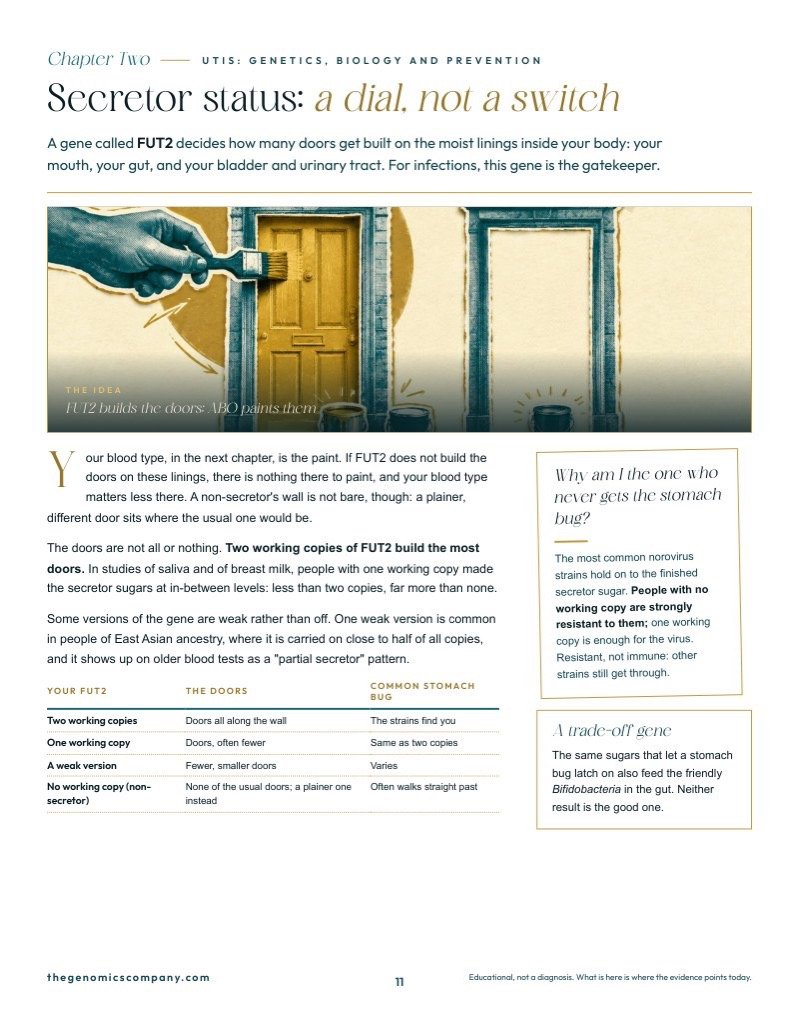
- Am I a secretor? The gene that decides whether your cells build the doors bacteria latch on to.
- What is my blood type? And when it matters.
The answers up front. Then the why, and what to do.
Answers first. Page 5 answers the questions people actually ask, from "Why do women get so many more UTIs than men?" to "What is the most important thing I can do?", each with the page that explains it.
- Why some women get UTIs and others don't. Anatomy, and the hooks bacteria use to hold on.
- The genetics: your secretor gene, the role your blood type plays, and what the research found.
- Estrogen across three seasons of life, partners, your gut and your bladder, and what to do when the test comes back negative.
Then, what to do with it. Plain English, and sourced so a skeptic can check it.
- Your five questions, on a two-page worksheet to print and fill in.
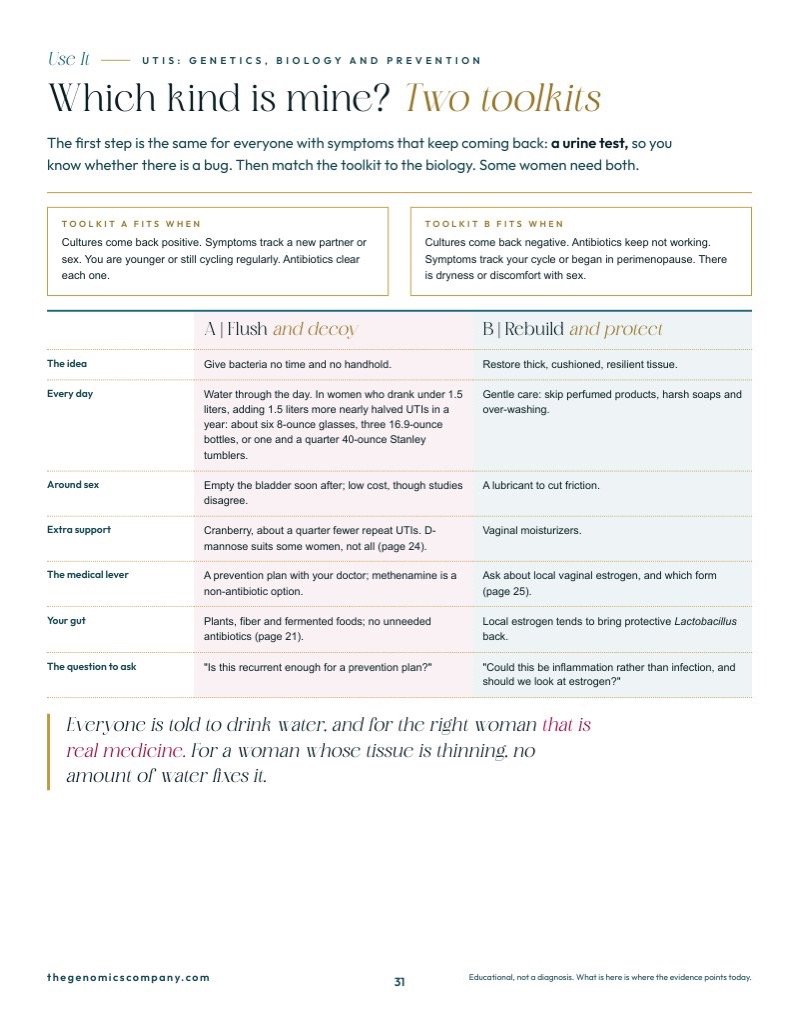
- Two toolkits, one for infection and one for thinning tissue, and how to tell which one is yours.
- What helps, and what the evidence says: water, cranberry, D-mannose, which vaginal estrogen, and the products on the pharmacy shelf, checked.
- Eight honest guardrails, and every source behind every number.
Your five questions
The genetics
The two toolkits
Where the science is settled, and where it is still moving.
Some of this story has been photographed down to the molecule. Some of it is still being worked out, because the people and the bacteria are not the same everywhere. The guide shows you which is which, so you can feel good about what you know.
Settled
Bacteria carry hooks, and each hook fits one sugar. The bladder hook grabs mannose; the kidney hook grabs the P blood group sugar.
Strong, still being studied
In study after study, non-secretors turned up two to three times as often among women and children with repeat infections. Results vary by place, and the guide explains why.
Promising, with open questions
D-mannose works on a real mechanism. The guide shows where the research stands, and what still needs to be tested.
I researched and read the science for a living. Now I teach it and interpret it for you personally.
Whichever part of your body you want to understand, from mood and sleep to hormones, detox and the heart, I teach you how your genes tend to shape it and interpret your results with you personally, so the foods, habits and questions you bring to your doctor fit how you are built.

Jennifer Little-Fleck, CFGP, BcID. Executive Biologist and Certified Functional Genomic Practitioner, with three decades in healthcare sales, research and medical writing. Specializes in connecting mood and behavior genetics to overall health.
This story runs on three genes. Your genome holds a great deal more worth reading.
The secretor gene and the clotting genes in this guide are part of a full genomic read. If you are interested in getting your DNA tested and joining a masterclass where we walk through the results together, book a quick conversation and we will get your test ordered.
There is no such thing as average. We help you read the plans that are yours.
The answers you have been looking for. And what to do with them.
Delivered as a PDF the moment you check out. For education; it describes tendencies, not a diagnosis.