Everything, in detail.
Most companies make you book a call to find out what you're getting. Here is all of it, in plain English.
Not hypotheticals. Things you've wondered about yourself for years.
Grouped by the report section that speaks to each one. Every one of these has a page in your results.
Sleep and energy
How My Body Sleeps
- Why do I wake at 3 a.m. even when I go to bed exhausted?
- Why do I need nine hours when my partner is fine on six?
- Why am I wide awake at 11 p.m. and useless at 8 a.m.?
- Why does exercise energize everyone else and flatten me?
Food, caffeine, and alcohol
How Food Affects My Body
- Why does one coffee keep me up all night when my friend sleeps after espresso?
- Why does one glass of wine give me a headache?
- Why do I gain weight on the exact diet that works for my sister?
- Am I actually getting anything from these supplements?
Mood, stress, and focus
How My Brain Is Wired
- Why does stress hit me physically when others shrug it off?
- Why do I do my best work under pressure and fall apart when things are calm?
- Why can't I "just relax" the way people keep telling me to?
- Why does my mind keep circling the same thought at midnight?
Medication response
How I Respond to Medication
- Why did that medication do nothing for me when it works for everyone else?
- Why do I get side effects at doses other people tolerate fine?
- Why did one antidepressant, statin, or painkiller work and another didn't?
- What should my prescriber know about me before the next prescription?
Nutrients and methylation
How Food Affects My Body
- Why do I feel worse after taking B vitamins?
- Is my vitamin D actually being used, or just measured?
- What does MTHFR really mean for me, past the internet noise?
- Which of the bottles on my counter are doing anything?
Environment and clearance
How My Body Cleans My Cells
- Why do perfumes, cleaning products, or smoke bother me so much?
- Why do I react to things nobody else in the room notices?
- Why does my histamine flare with no obvious pattern?
- Why does aged cheese, or red wine, land differently on me?
Hormones
How My Hormones Are Wired
- Why did my body change so much faster than my friends' did?
- Why do hormone shifts hit me harder than they seem to hit other people?
- Should I do HRT or TRT, and how would my body handle it?
- What should I actually be asking my doctor about?
Immune system
How My Immune System Works
- Why do I catch everything going around when the people next to me don't?
- Why does a cold take me two weeks and my partner two days?
- Why does inflammation seem to linger in me after the cause is gone?
- Which of my family's autoimmune tendencies might I carry?
Heart and the long game
How My Heart and Blood Vessels Perform
- My cholesterol is "fine," so why do I still worry about it?
- Which of the hundred heart-health rules actually apply to me?
- Am I going to get heart disease like the other men in my family?
- What's worth doing now rather than at sixty?

"You can't even do your part if you don't know. There are so many people out there committed to doing their part, and they're doing the wrong thing."
Jeff Hancher
National bestselling author, keynote speaker, and leadership development expert
Every company in this space implies the test answers everything. It doesn't.
- A predisposition is not a prediction."Increased" means your inherited baseline sits above average. It does not mean you will develop anything. Environment, behavior, age, and chance shape most outcomes more than any single variant.
- This cannot diagnose you.It can show the tendencies and sensitivities that contribute to how you feel. Diagnosis is your physician's; explanation is often mine. If you are unwell now, start with a physician.
- This is not clinical genetic testing.BRCA, Lynch, Huntington's, or another specific inherited disorder belongs with clinical genetic testing through your physician. A family pattern of common conditions is a different thing, and it is exactly this work.
- This cannot tell you what medication to take, or at what dose.That is your prescriber's decision. Your results are information to bring to that conversation, never a reason to change anything on your own.
- This cannot tell you how long you'll live,or guarantee that any change will produce any particular result.
Some results land heavier than others. When one of yours does, I'll say so plainly, and tell you when it's worth reviewing with your physician.
You don't build a building without the architectural plans.
01
Genes first
Your baseline tendencies. The plans.
02
How you feel now
And how you want to feel.
03
Where you are today
Your labs, read against the plans.
04
Close the gaps
With lifestyle and environment.
Not a supplement company wrapped around a genomic test. A biologist, reading the plans with you.
For the people who want the specification before the story.
| What it reads | The Lifestyle Panel: about 1,100 SNPs, chosen for how the genes function, not for disease screening, across nine body systems. New questions can be answered from the same sample later. |
|---|---|
| Pharmacogenomics | Core pharmacogenomics: the most clinically important drug-gene pairs. In plain English, how your genes shape the way your body handles medication: how quickly you clear it, how strongly it hits, and why the same dose acts differently from person to person. With a prescriber wallet card and a physician document. |
| Reviewed together | About 100 main functional genes, the ones that carry most of the practical signal, across nine systems, one system a week. |
| Your portal | Your online portal, with polygenic scoring reports, included with every program. Every result has a page; the course teaches you how to read one. |
| What's measured | A combination of individual gene variants and polygenic scores; see The science below for what each can and can't do. |
| Collection | Saliva, collected at home. No blood, no clinic visit, no appointment. Five minutes, then the return mailer. |
| Your bloodwork | Read alongside your genetics, which is where the useful answers tend to live. |
| Yours for life | You never test again. New questions are answered from the same sample as the panel grows, and your results stay yours. |
The nine systems
The laboratory reads the letters. I read you.
The laboratory is a supplier, chosen for accuracy and for handing over everything it reads. The reading, the writing, and the person across the desk are The Genomics Company, and they do not change when a supplier does. Want the platform and certification details? Ask in a live session; I'm happy to walk through them.
| What's reported | About 1,100 SNPs on the Lifestyle Panel, with core pharmacogenomics; about 100 functional genes reviewed in the program. |
|---|---|
| Turnaround | Three to six weeks, depending on where in the world you are. |
| Your kit | Ships under our name, direct to your door, and returns direct to the laboratory. International shipping is available for most countries. |
| The sample | Kept for up to six months in case a run needs repeating, then destroyed. Not sold, not used for research. |
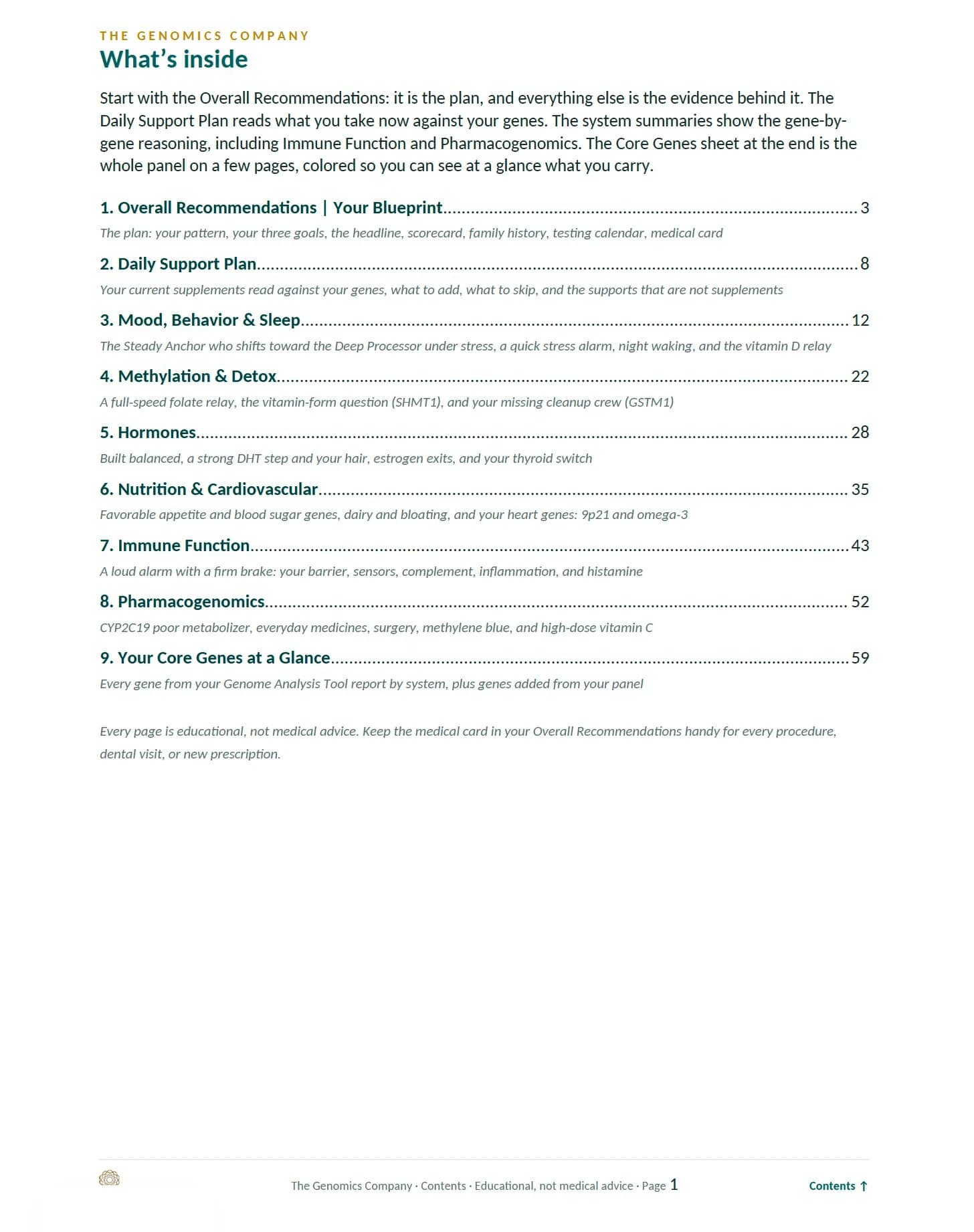
The contents page of a real Complete Blueprint (You, In Full), not the Personal Overview. Every client's is written from their own results.
The results are the raw material. This is the reading.
Your Personal Overview comes with every program: your priority findings by body system, the pattern underneath them, and what to do first. About five pages, written by me.
The Complete Blueprint for all nine systems comes with You, In Full: every curated gene, gene by gene, with your bloodwork read alongside, and an appointment prep page for your doctor where a result deserves a real conversation.
You, In Full also keeps every one of the 670,000 SNPs on your array, annotated and on file. Not a document you read; the reserve I read from when a question comes up in year three, so the answer is already in hand.
Four steps. You do the first one.
01
Your kit arrives
Posted to your door. Collection takes about five minutes at home; you send it back in the packaging provided.
02
The laboratory runs it
Three to six weeks later, depending on where you are, your results are in your online portal, polygenic scoring reports included. The first chapter shows you where everything lives and how to read a page.
03
I write, then we talk
I read your results and write your Personal Overview. Then your private 90-minute session walks through what matters and what to do.
04
The course, then the workshops
The online video course, one chapter per system, plus nine weeks of optional live workshops. Join any week; nine weeks later you've covered all of it.
"Take the five minutes it literally takes to complete the process. It is something that will definitely change your life. When it comes to your wellbeing and health you can never put a price or timeframe on what inevitably shapes the rest of your life."
Walter Sadauskas, Genomics Immersion client
Three things worth understanding before you look at any genetic result.
Single variants and polygenic scores
Some results come from one gene with a well-studied effect, like how fast you clear caffeine. Others are polygenic scores: thousands of small effects added into one number. They describe populations well and individuals only roughly. A tendency, not a verdict.
Ancestry affects accuracy
Most polygenic research was done in people of European ancestry, so those scores are held more loosely for everyone else. Single-gene results are far less affected. Where your ancestry makes a result less reliable, I say so.
Genes are one input among several
Your genetics are fixed. Almost nothing else about your health is. Genes set the tendencies; lifestyle and environment decide which of them you feel. On its own it is a map. With context, it becomes a decision.
Given what happened to the last generation of consumer DNA companies, this deserves a straight answer.
Who owns it
You do. Your results are held under your account, and your genotype file is yours to keep.
Is it sold?
No. Not to insurers, not to advertisers, not to data brokers, under any circumstances.
Research use
Not without your explicit, specific consent. Declining changes nothing about your access.
Can you download it?
Yes. Your data and your written reports are exportable, and I encourage you to keep a copy.
Can you delete it?
Yes, on request. Say the word and it is removed.
The physical sample
Kept for up to six months in case a run needs repeating, then destroyed.
I'd rather you not buy this than buy it expecting something it isn't.
- Anyone looking for a diagnosis. If you're unwell right now and want to know why, start with a physician. This won't get you there, and waiting on it could cost you time.
- Anyone who suspects a single-gene hereditary syndrome. BRCA, Lynch, Huntington's, or another specific inherited disorder is clinical genetic testing through your physician: a different service, properly regulated, and the right one for that question.
- Anyone hoping to be told what to take and nothing more. This is an education product. You'll finish it understanding your own biology, which takes some engagement.
- Anyone who wants certainty. Genetics deals in tendencies. If a probabilistic answer will frustrate you, this will frustrate you.
- Anyone currently in crisis. This is built for people with the time and space to learn something. That is a real prerequisite, not a polite one.
You're not sick yet, and you're already doing everything right. Read this.
A family pattern tells you something is running through your line. It doesn't tell you which parts you inherited, or which of them respond to anything. That is the question this answers: not "will it happen to me," but "which pieces are in me, and which levers respond."
A pattern of common conditions is exactly this work. A specific inherited disorder belongs with clinical genetic testing first, and I'll tell you plainly if that's what I'm seeing.
One program. Two ways to have it explained.
The Genomics Immersion. $2,950.
The Lifestyle Panel with core pharmacogenomics, your online portal with polygenic scoring reports, your Personal Overview, one private 90-minute session, the online video course plus nine weeks of optional live workshops, and three months in the Genomics Lounge. Payment plans at checkout.
Want it handled? You, In Full. $6,500.
No modules, no homework. The Complete Blueprint for all nine systems; up to three years of bloodwork read alongside, with one lab draw included in the USA; at least three private 90-minute sessions and a follow-up, with questions answered by text or email in between; all 670,000 SNPs on your array, annotated and kept on file; the custom physician document; and six months in the Lounge. Limited each month.
More than one of you? The Family Immersion, $5,000 for two.
$2,150 for each person after that. Test two or three and you see where it came from.
If something still isn't clear, that's a fair reason to talk: fifteen minutes, free. If it is clear, there's no need to.
The test is the easy part. Understanding it is what you're really paying me for.
Saliva at home · Read with you personally · In plain English