The Four Patterns.
Why you handle stress, sleep, mood, and recovery the way you do. And why the person beside you, living the very same week, ends up somewhere completely different. Two settings, four baseline patterns, and one of them is yours.
Where should I send it?
The guide arrives in your inbox in a minute or two. No spam, and you can unsubscribe any time.
One of them has reset by Wednesday. The other is still awake on Friday.
Two people go through the same stressful stretch. The same deadline, the same bad news, the same run of nights with too little sleep. We tend to explain the gap with character: she is tougher, he is too sensitive. It is usually not character. It is chemistry, and most of the settings were in place before you were born.
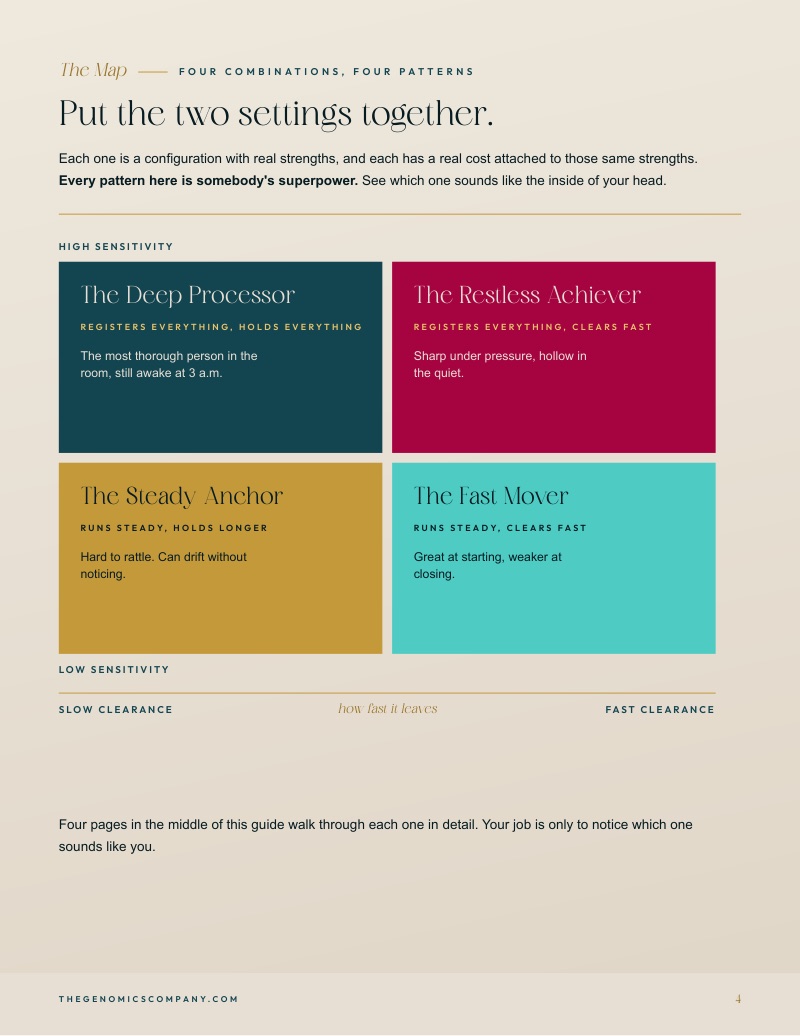
Two settings do most of the work: how much signal your nervous system takes in, and how fast your body clears stress chemistry once it has. Put them together and you get four baseline patterns. Every one of them is somebody's superpower, and every one has a cost attached to the same strengths.
High sensitivity · Slow clearance
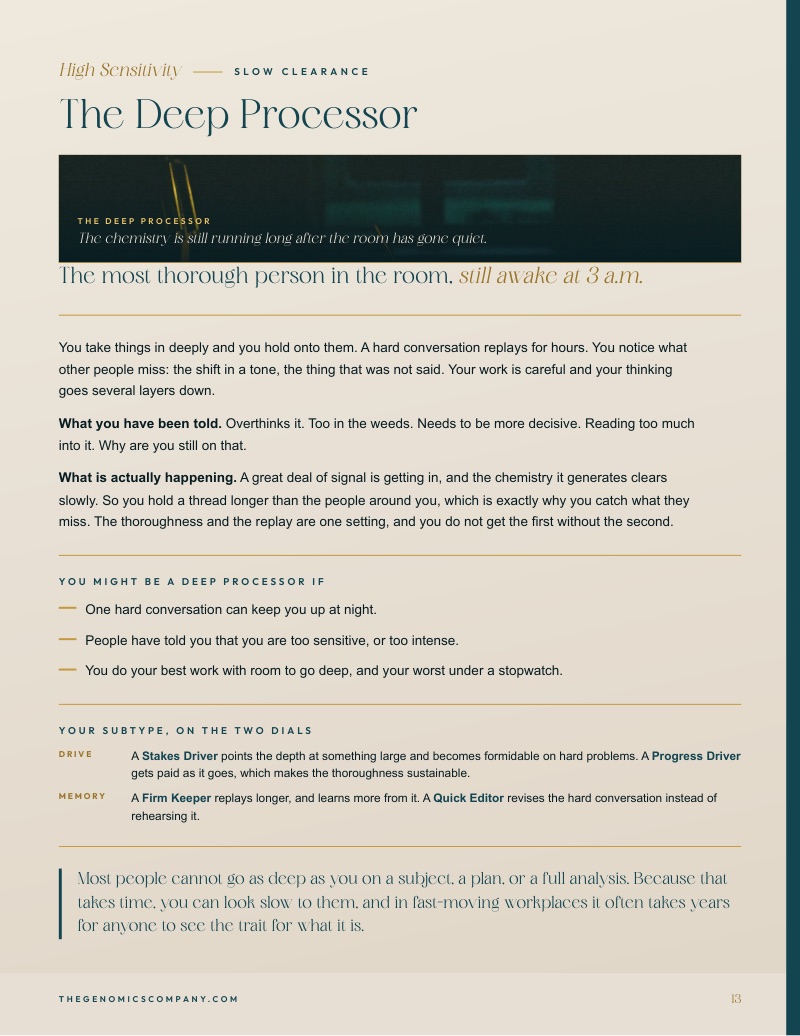
The Deep Processor
The most thorough person in the room, still awake at 3 a.m.
High sensitivity · Fast clearance
The Restless Achiever
Sharp under pressure. Hollow in the quiet.
Low sensitivity · Slow clearance
The Steady Anchor
Hard to rattle. Can drift without noticing.
Low sensitivity · Fast clearance
The Fast Mover
Great at starting, weaker at closing.
Your only job is to notice which one sounds like the inside of your head.
A personality trait with a body attached.
- Two settings, four patterns. The two questions underneath all the complexity, and the map they make.
- Why this is a health document. The known routes from a hard week to your immune system, your sleep, and your recovery.
- Twelve questions this pair of settings answers. Why it takes you longer to stop being stressed, what time your body gets the memo, and why quiet feels like relief to some people and boredom to you.
- Two pages per pattern: what you have been told, what is actually happening underneath it, and what it costs you.
- Your pattern moves. A home, not a cage: how a lean sits inside a quadrant, or close to a line.
- Four dials in one place: the two that set your pattern, and the two that color it in.
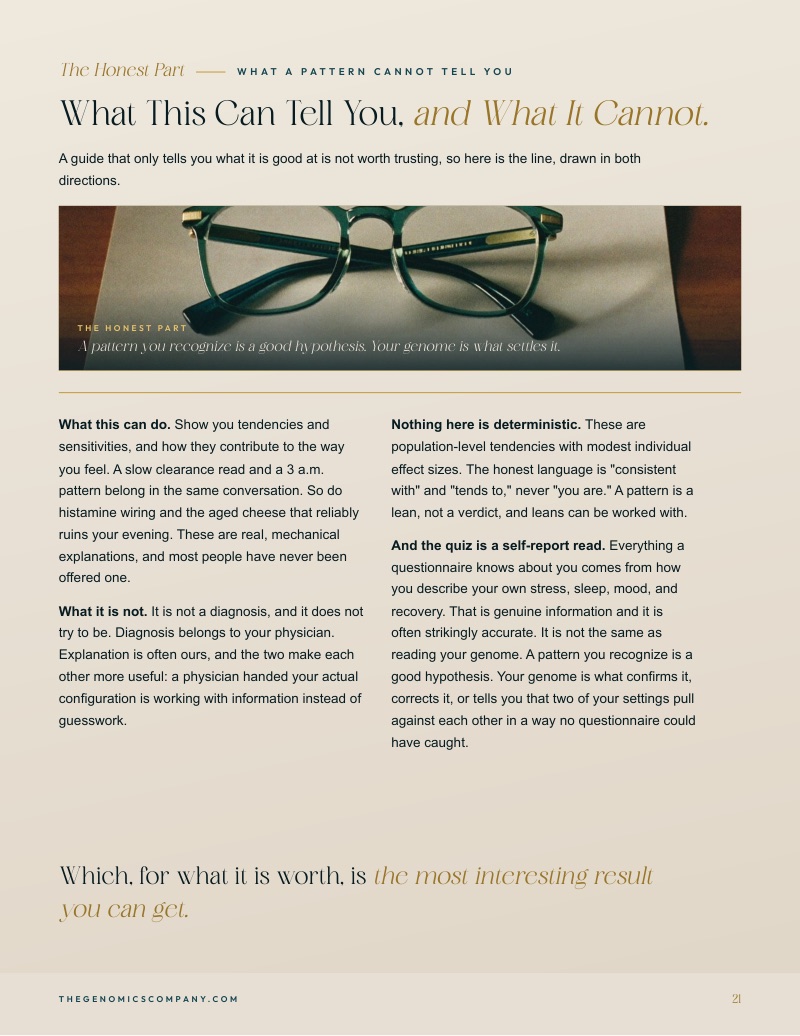
- The honest part: what a pattern can tell you, and what it cannot. Consistent with, never you are.
The map
One of the four, in full
The honest part
Most people are surprised by how much of themselves is a tendency. That is good news.

The four patterns are the first thing I read in a genome, because stress chemistry runs through sleep, mood, energy, and how you recover. The guide gives you the words for something you have probably felt your whole life. Nothing in it is deterministic: a pattern is a lean, not a verdict, and leans can be worked with.
Jennifer Little-Fleck, CFGP, BcID. Executive Biologist and Certified Functional Genomic Practitioner, with three decades in healthcare sales, research and medical writing. Specializes in connecting mood and behavior genetics to overall health.
The thing you would have given anything to understand at twenty-five. You can know it now.
Educational, not medical advice. For questions about a diagnosis or a medication, talk with your physician.